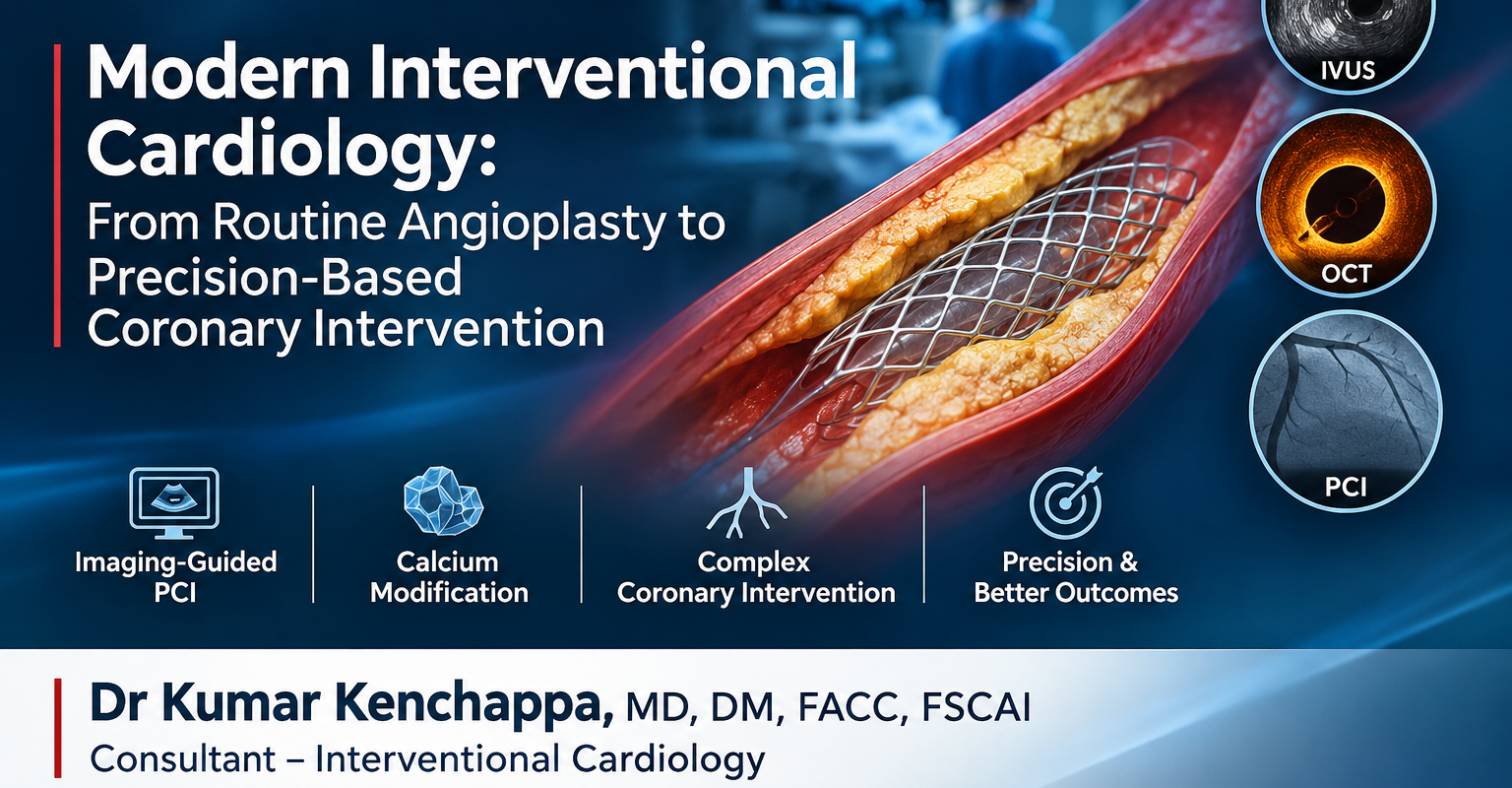
The evolution of coronary intervention
Interventional cardiology has undergone a remarkable transformation over the past two decades. What was once largely an angiography-guided procedure has evolved into a sophisticated, imaging-driven discipline that increasingly focuses on understanding coronary plaque morphology, vessel architecture and the mechanisms of stent failure.
Today, the success of percutaneous coronary intervention (PCI) is no longer defined simply by achieving a good angiographic result. It is about achieving optimal stent expansion, ensuring adequate lesion preparation, minimizing complications and improving long-term clinical outcomes.
The shift is from angiographic success to precision-based revascularisation.
1. Intravascular imaging: Looking beyond the angiogram
Coronary angiography provides an essential roadmap, but it has inherent limitations. It is a two-dimensional representation of a complex three-dimensional vascular structure.
Intravascular ultrasound (IVUS) and Optical Coherence Tomography (OCT) have changed the way we approach complex coronary interventions.
These technologies allow us to:
* Understand plaque composition and distribution.
* Assess vessel dimensions and reference diameters.
* Identify the extent and morphology of coronary calcification.
* Optimize stent sizing and landing zones.
* Identify underexpansion, malapposition and edge dissections.
* Investigate mechanisms of stent failure.
The growing clinical evidence supporting imaging-guided PCI is particularly compelling in complex coronary lesions, including left main disease and bifurcation interventions.
The 2025 ACC-AHA Acute Coronary Syndromes guidelines recommend IVUS or OCT guidance for PCI involving the left main artery or other complex lesions in ACS patients.
The message is clear: What we cannot adequately appreciate on angiography may be critical to the final procedural outcome.
2. Calcium modification: Choosing the right tool for the right lesion
One of the greatest challenges in contemporary PCI is the management of severely calcified coronary lesions.
Heavy coronary calcification can prevent adequate balloon expansion, restrict stent delivery and result in stent underexpansion – an important substrate for subsequent adverse events.
We now have several calcium modification strategies:
* Rotational atherectomy (RA)
* Orbital atherectomy (OA)
* Intravascular lithotripsy (IVL)
* Cutting and scoring balloons
* Other lesion preparation techniques, selected according to anatomy and lesion morphology.
However, the important question is not simply which device is available, but which device is appropriate for the particular lesion.
Understanding calcium arc, thickness, length, depth, distribution and guidewire bias can help determine the most suitable approach.
Intravascular imaging has therefore become an important component of calcium modification strategies, helping us select the appropriate technique and assess the effectiveness of lesion preparation.
The objective is not aggressive plaque modification for its own sake. It is to achieve adequate vessel compliance and facilitate optimal stent expansion while minimizing procedural complications.
3. Complex coronary interventions: Planning is everything
Left main interventions, bifurcation PCI, chronic total occlusions and heavily calcified lesions demand more than technical expertise.
They require careful procedural planning, appropriate equipment selection and anticipation of potential complications.
In complex PCI, the operator must consider:
* Anatomical complexity and myocardial territory at risk.
* Haemodynamic stability and ventricular function.
* Appropriate guide catheter selection and support.
* Guidewire strategy and lesion preparation.
* Imaging-guided stent optimization.
* Complication management and bailout strategies.
The availability of advanced techniques has expanded the boundaries of what can be achieved percutaneously. However, the fundamentals of coronary intervention remain equally important.
Good judgement, meticulous technique and knowing when not to intervene are as important as mastering newer technologies.
4. The future: Precision, personalization and better outcomes
The next phase of interventional cardiology will increasingly integrate intracoronary imaging, physiology, advanced plaque modification and newer-generation stent technologies.
We are moving towards a more individualized approach to coronary revascularisation, where the treatment strategy is tailored to the patient’s anatomy, plaque characteristics, clinical presentation and overall risk profile.
Technology should complement clinical judgement, not replace it.
The ultimate goal remains unchanged: to provide safe, effective and durable revascularisation.
Dr Kumar Kenchappa, MD, DM, FACC, FSCAI
Interventional Cardiologist
Interventional cardiology has undergone a remarkable transformation over the past two decades. What was once largely an angiography-guided procedure has evolved into a sophisticated, imaging-driven discipline that increasingly focuses on understanding coronary plaque morphology, vessel architecture and the mechanisms of stent failure.
Today, the success of percutaneous coronary intervention (PCI) is no longer defined simply by achieving a good angiographic result. It is about achieving optimal stent expansion, ensuring adequate lesion preparation, minimizing complications and improving long-term clinical outcomes.
The shift is from angiographic success to precision-based revascularisation.
1. Intravascular imaging: Looking beyond the angiogram
Coronary angiography provides an essential roadmap, but it has inherent limitations. It is a two-dimensional representation of a complex three-dimensional vascular structure.
Intravascular ultrasound (IVUS) and Optical Coherence Tomography (OCT) have changed the way we approach complex coronary interventions.
These technologies allow us to:
* Understand plaque composition and distribution.
* Assess vessel dimensions and reference diameters.
* Identify the extent and morphology of coronary calcification.
* Optimize stent sizing and landing zones.
* Identify underexpansion, malapposition and edge dissections.
* Investigate mechanisms of stent failure.
The growing clinical evidence supporting imaging-guided PCI is particularly compelling in complex coronary lesions, including left main disease and bifurcation interventions.
The 2025 ACC-AHA Acute Coronary Syndromes guidelines recommend IVUS or OCT guidance for PCI involving the left main artery or other complex lesions in ACS patients.
The message is clear: What we cannot adequately appreciate on angiography may be critical to the final procedural outcome.
2. Calcium modification: Choosing the right tool for the right lesion
One of the greatest challenges in contemporary PCI is the management of severely calcified coronary lesions.
Heavy coronary calcification can prevent adequate balloon expansion, restrict stent delivery and result in stent underexpansion – an important substrate for subsequent adverse events.
We now have several calcium modification strategies:
* Rotational atherectomy (RA)
* Orbital atherectomy (OA)
* Intravascular lithotripsy (IVL)
* Cutting and scoring balloons
* Other lesion preparation techniques, selected according to anatomy and lesion morphology.
However, the important question is not simply which device is available, but which device is appropriate for the particular lesion.
Understanding calcium arc, thickness, length, depth, distribution and guidewire bias can help determine the most suitable approach.
Intravascular imaging has therefore become an important component of calcium modification strategies, helping us select the appropriate technique and assess the effectiveness of lesion preparation.
The objective is not aggressive plaque modification for its own sake. It is to achieve adequate vessel compliance and facilitate optimal stent expansion while minimizing procedural complications.
3. Complex coronary interventions: Planning is everything
Left main interventions, bifurcation PCI, chronic total occlusions and heavily calcified lesions demand more than technical expertise.
They require careful procedural planning, appropriate equipment selection and anticipation of potential complications.
In complex PCI, the operator must consider:
* Anatomical complexity and myocardial territory at risk.
* Haemodynamic stability and ventricular function.
* Appropriate guide catheter selection and support.
* Guidewire strategy and lesion preparation.
* Imaging-guided stent optimization.
* Complication management and bailout strategies.
The availability of advanced techniques has expanded the boundaries of what can be achieved percutaneously. However, the fundamentals of coronary intervention remain equally important.
Good judgement, meticulous technique and knowing when not to intervene are as important as mastering newer technologies.
4. The future: Precision, personalization and better outcomes
The next phase of interventional cardiology will increasingly integrate intracoronary imaging, physiology, advanced plaque modification and newer-generation stent technologies.
We are moving towards a more individualized approach to coronary revascularisation, where the treatment strategy is tailored to the patient’s anatomy, plaque characteristics, clinical presentation and overall risk profile.
Technology should complement clinical judgement, not replace it.
The ultimate goal remains unchanged: to provide safe, effective and durable revascularisation.
Dr Kumar Kenchappa, MD, DM, FACC, FSCAI
Interventional Cardiologist
Keywords